Most of the conversation around WWDC26 has been about one thing: Apple tightening App Store review. Stricter guidelines, saturated categories getting named, retroactive removals — the feeds have been chewing on this for days, and that attention is warranted because real consequences are landing for builders in crowded niches.
But the spam story is not the whole story behind WWDC26. We watched the sessions, scanned the news, and discussed it within the team to decode and highlight what actually matters for subscription apps.
TL;DR
Eight changes, team verdict on each, and one question running through them all: where is the App Store actually moving?
In this article:
- Apple Tightens Compliance Beyond the Spam List
- App Intents Decide Your Visibility to Siri
- Four New Ways to Sell Subscriptions Arrive at Once
- Commitment Plan Closes the Monthly-Annual Gap
- Retention Messaging Reaches the System Cancel Flow
- Personalized Collections Turn Retention Into Discovery
- Creative Assets Decouple ASO From Release Cycles
- Foundation Models Go Free for Small Developers
Whether all of this will work the way Apple framed it is another story. We decoded each one, including the parts Apple did not advertise.
Apple Tightens Compliance Beyond the Spam List
1,000 apps submitted to the App Store every hour is the number Tim Cook dropped in the WWDC26 keynote. Submissions grew 84% in a single quarter, the biggest jump in a decade. Vibe-coding tools collapsed the cost of shipping an app to a weekend and a prompt, and the store is taking the hit.
Apple is responding with the heaviest hand the store has seen in years, and the new rules reach further than the headlines suggest.
What Apple said. Apple put a direct call-out in the updated 4.3 guideline: "the App Store has enough fart, burp, flashlight, fortune telling, dating, drinking games, and Kama Sutra apps." Such kinds of apps are effectively closed for new submissions. The guideline goes further: any app entering a saturated category now has to demonstrate a fundamentally different user experience to make it through review. Existing apps that no longer maintain themselves can also be removed retroactively. A second compliance shift lands in parallel. From July 2026 (optional) and September 2026 (mandatory), any app with social media capabilities has to declare it, gets a minimum age rating of 13+, and falls into the new Time Allowance Social Media category in Screen Time.
What it actually means. The named spam list grabs attention, but the bigger move sits one level above it. The crowded-category rule applies to fitness, meditation, astrology, language learning, and most subscription niches teams are actually working in. The bar for "meaningfully different" moved up, and a polished clone in a saturated market is no longer enough. If Apple's review bar keeps rising, "App Review Specialist" could become a real role on the developers' side.
The social-feature trap is the quieter cost. Apple's questionnaire flags "social media capabilities" without a sharp definition, so the line between obvious cases and the grey zone (shared progress, leaderboards, comments, friend invites, in-app messaging) gets drawn by the reviewer. Declare any of it, and the app picks up a 13+ rating and lands in the same Screen Time Social Media timer as Instagram and TikTok. Worth auditing the portfolio before September.
And on top of that, the assistant changes the game. While Apple tightens what gets into the store, it also lifts the AI assistant living inside the iPhone to a level that overlaps directly with paid subscriptions. The new Siri runs on a custom Google Gemini model — Apple finally delivered the rebuilt assistant it promised two years ago, this time with an external engine doing the heavy lifting. Camera now reads a restaurant check and splits it through Apple Cash, points at a plate and logs nutrition into Health, scans a poster and adds the event to Calendar. Photos picks up Spatial Reframing, Extend, and a stronger Cleanup. Shortcuts get generated from natural language: describe a routine and Siri assembles it. On top of that, Siri reaches into Messages, Photos, Files, and third-party apps, surfaces context across them, and runs multi-step prompts in a single conversation.
The full Siri AI experience requires iPhone 15 Pro or newer and is not available in the EU or China at launch, so the reach starts narrow. The catch is that this is exactly the audience that pays for subscriptions in the first place, and Apple's direction of travel is clear. In two or three release cycles, today's flagship features become the iPhone baseline. Whole categories of paid apps just lost a clean chunk of their value to the OS itself: photo editors, calorie trackers, bill splitters, document scanners, automation tools, AI chat wrappers. Any third-party app now has to prove two things at once: that it does something competitors don't, and that it goes beyond what the iPhone already does on its own.
"At risk are products where value equals one function without data: utilities, wallpapers, timers, generic dating, horoscopes, simple AI wrappers. The winners are products with content depth and accumulated user data — learning, health, finance — the kind of thing you can't reproduce in a weekend.
That said, it changes the iteration economics. The 'ship 10 thin MVPs and see what sticks' model gets more expensive: every submission now has to carry a defensible differentiation story you can show to a reviewer. The dangerous wording in the updated guideline is the other one — 'indistinguishable from what's already widely available.' It's subjective and gives the reviewer a club against any app assembled from a template, which is exactly what the studio model with a reusable codebase looks like.
Every MVP needs one reviewable differentiator you can name in Review Notes — proprietary content or data, a non-standard mechanic, a real service backend. Not 'another tracker with different UI.' The portfolio has to be kept alive — a maintenance cadence with at least a quarterly SDK bump and metadata refresh for everything we want to keep. And the social features audit before September has to happen per app, with decisions made in July when declaration becomes optional."
— Sergey, Full Stack Developer, Talaboos
"Thin MVPs in saturated niches don't get validated through the store anymore. Demand gets tested through a web2app funnel where Apple review isn't part of the equation, and only a proven product gets shipped to the store afterward."
— David, Head of UA, Talaboos
"Nothing radical changes for us at this point. Apple keeps raising the bar on real product value and pushing back harder against clones and template apps. For us that's more of an upside than a downside."
— Dmitry, Product Manager, Talaboos
App Intents Decide Your Visibility to Siri
The Siri rebuild has a flip side for developers. To get any of the assistant's new power working with a third-party app, the app has to expose its content and actions through App Intents. Apps that don't, become invisible to the new Siri the day iOS 27 ships this fall.
What Apple said. App Intents is now the only framework that connects a third-party app to Siri AI. SiriKit, the previous integration layer that has been around since 2016, received a formal deprecation notice with a multi-year sunset window. Apps that adopt App Intents become discoverable through voice, contribute content to the Spotlight semantic index, and surface inside multi-step Siri conversations. Apps that don't, sit outside this layer entirely. iOS 27 ships in September.
What it actually means. This is both a deadline and an opening. The deadline is concrete: if the app does not implement App Intents before iOS 27, it disappears from a retention surface that will live on every flagship iPhone. The opening is the part most coverage misses. Siri AI becomes a new entry point into the app, parallel to the home screen and notifications, and publishers that wire up the right intents early own that entry point before competitors arrive. Continue a lesson, resume progress, open a recent test, pull up a saved item — anything that shortens the path from intent to action becomes a way back into the product without the user opening it manually. For product teams, that is a re-engagement channel that did not exist a year ago. The publishers that get there first treat App Intents as a product decision. The migration follows from there.
"App Intents opens a new distribution surface: an app without intents goes invisible to the voice layer the moment iOS 27 ships, the way a website without indexing is invisible to search. Implementing it is necessary, but the panic is overdone. In the first year voice traffic is unlikely to become a meaningful channel — launch is English-only, no EU or China, which cuts the addressable audience hard.
The first intents to wrap are the ones that close the user's frequent tasks and return value in a single request, without opening the app. That turns Siri into a trigger for a daily habit, which directly drives retention. And retention, given the other updates this year, now also feeds the organic.
There's a risk most coverage skips. A powerful assistant in every phone commoditizes simple utilities. If a subscription sells what Siri now does for free by voice command, the problem isn't App Intents — it's the product itself. The products that survive are the ones with ritual, content, and identity. The future is the user experience, which keeps the balance between marketing and a strong product."
— David, Head of UA, Talaboos
"Worth implementing. The value multiplier matters: App Intents isn't only Siri — the same code feeds Spotlight, Shortcuts, and Apple Intelligence suggestions. The traps are real. Intents can bypass the paywall: Siri triggers an action directly, so entitlement checks have to live inside the intent itself, otherwise a paid feature gets handed out for free by voice. Opaque ranking: when a user request is ambiguous, which app Siri picks is unknown — Apple doesn't disclose it, so the first few months mean optimizing blindly for a new 'discovery algorithm.' Voice scenarios automate poorly and the QA matrix grows."
— Sergey, Full Stack Developer, Talaboos
"For us — RN with a shared codebase — this means another native Swift module and bridge, a separate iOS branch of logic. A basic integration of a few key intents is moderate work. A deep one — content on request, parameterized actions, returning results inside Siri — is significant native work and ongoing maintenance. There may be no ready-made bridges for richer App Intents, so we'd write part of it natively ourselves. And it's the quality of the intents that matters, not the fact of having them — poorly described ones get triggered awkwardly by Siri."
— Vladislav, Full Stack Developer, Talaboos
Four New Ways to Sell Subscriptions Arrive at Once
Apple opened four new commercial structures at once, and together they represent the biggest shift in App Store monetization since the introduction of subscriptions in 2016.
What Apple said. Four new mechanics arrive over the next year:
- Bundles: multiple subscriptions packaged together at a discount. The new piece is that bundles can now cross developer accounts, so independent teams can combine subscriptions into a single offer.
- Suites: combined offerings that exist only as a package, not for sale individually.
- Group Purchases: one buyer pays, multiple seats get access, invites sent to others. Launches winter 2026.
- Volume Purchasing: enterprise and education lots through Apple Business Manager and Apple School Manager. Launches fall 2026.
What it actually means. Each mechanic targets a different gap in the App Store monetization model, and not all of them matter equally.
Cross-developer Bundles is the most consequential shift. Until now, packaging subscriptions across studios required custom payment flows outside the store. Apple now offers it as a native feature, which opens a path that did not exist before: small teams with complementary products can combine forces against larger competitors without building their own infrastructure. Suites apply the same logic inside a single developer's portfolio, useful for teams running multiple apps.
Group Purchases and Volume Purchasing both extend the buyer pool but in different directions. Group is consumer-facing: family plans, study groups, friend circles. It opens a sales channel that has been the territory of Spotify, Netflix, and a few others for a decade. Volume is B2B: corporate licenses, schools. Most consumer subscription products will not need it, but the few with workplace or education use cases now have a clean path.
The four mechanics together open a sales surface that did not exist three months ago, and ignoring it seems like a bet against where the store is moving. The Bundles and Suites API is already available in Xcode 27 for prototyping, with full program details coming later in summer 2026.
"Suites inside our own portfolio would be the first format to test. An offering that doesn't exist standalone lifts blended LTV without eroding revenue through discounts. With mixed products, careful is the word: the user has to read the logic of the package in a second.
On cross-developer bundles I'm a skeptic, at least in the short term. The unresolved question sits in UA economics: how to split revenue, who gets credit for acquisition, how to calculate payback on a package. On paper the upside is mutual — the anchor with the audience gets an extra sale almost for free, the smaller product gets distribution. In practice the negotiation overhead and attribution disputes will kill most of these collaborations. Anchors come out ahead — they have the stronger negotiating position."
— David, Head of UA, Talaboos
"It's not yet clear how pricing and cancellations will work, what happens to a bundle when a user wants to leave one product, how that ripples through retention on the rest, and how revenue is attributed inside a bundle to understand which product actually retains the user. Apple has promised the detailed mechanics later this summer 2026, but for now several questions stay open.
This is genuinely the biggest monetization change since 2016, and worth a serious look. But the first reasonable step is small — an internal Suite on logically connected products from the portfolio, with honest measurement of incremental revenue, rather than a broad bet on cross-developer bundles."
— Vladislav, Full Stack Developer, Talaboos
Commitment Plan Closes the Monthly-Annual Gap
Apple quietly launched Commitment Plan in April 2026, and reframed it at WWDC alongside the new bundle and group mechanics.
What Apple said. Commitment Plan sits between the two existing options. The user pays monthly, but commits to all 12 payments upfront. They get the price of an annual plan with the entry barrier of a monthly one, and the developer gets annual retention without the upfront price wall. Configurable in App Store Connect, no code changes required.
One catch: Commitment Plan is not available in the US or Singapore.
What it actually means. Commitment Plan addresses a real pain of monthly-vs-annual choice, so for products with non-US traffic — EU, LATAM, APAC — it's a working test on paywalls today. For US-heavy products, it stays on the watchlist until Apple expands.
The broader signal matters more than the mechanic itself. Bundles, Suites, Group Purchases, and Commitment Plan all loosen a rule Apple held tight for a decade. App Store is moving toward flexibility under regulatory pressure (DMA in the EU, ongoing antitrust scrutiny in the US) and competitive pressure from web2app funnels that have already shown what flexibility looks like. For teams that have been on the web side of that fence, the gap is narrowing. The question is whether Apple's pace closes it fast enough to matter.
"Here Apple is catching up to what web2app has treated as normal for the last five years. On the web we've lived with flexible plans, pauses, downgrade ladders, and intro offers of any configuration for ages. So yes, App Store is becoming more flexible — from concrete slab to firm mattress. The gap to web funnels and paywalls is still a chasm. The mechanic itself works. Annual economics with a monthly payment barrier solves the main problem of the annual plan, the price shock at the paywall. In low-purchasing-power geos this can meaningfully move conversion into annual economics. The US exclusion makes the test niche, but with significant European and LATAM traffic it's worth trying right away.A real game changer would be something else: promo offers and win-back at the level of web flexibility, normal access to cohort data, and the ability to run pricing experiments by cohort without the regional-price gymnastics."
— David, Head of UA, Talaboos
Retention Messaging Reaches the System Cancel Flow
Apple brought the retention conversation inside the store. When a user hits cancel, the developer can now intervene at the system level — something that has lived only in custom in-app flows until now.
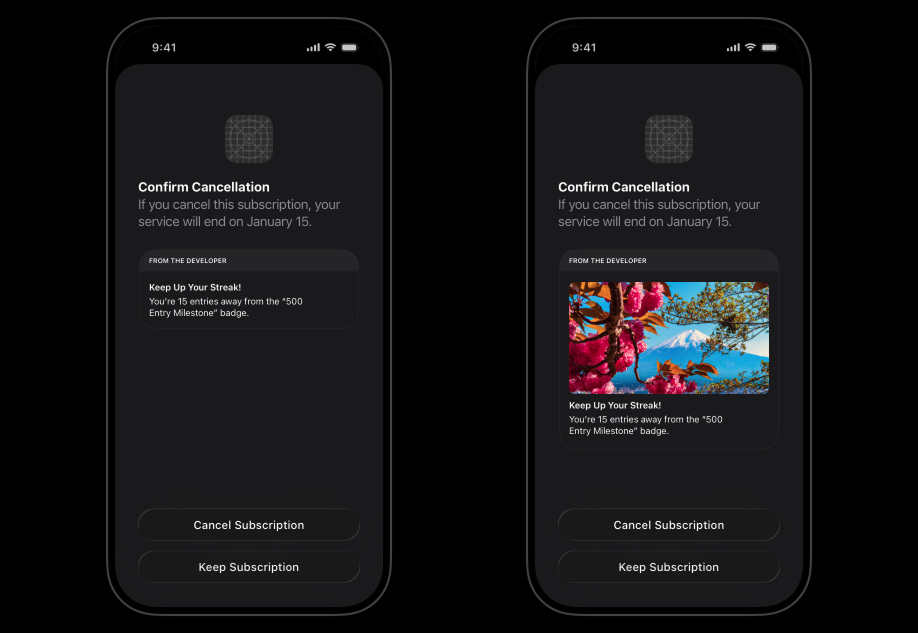
What Apple said. Retention Messaging is a new App Store Connect feature that lets developers display a custom message, retention offer, or reminder of value when a user starts the cancellation flow inside the system settings. Apple shared early benchmark uplifts from the Retention Messaging beta: +1.4 points on save rate baseline (an 82% lift) and up to +5.5 points when paired with promo offers (a 223% jump).
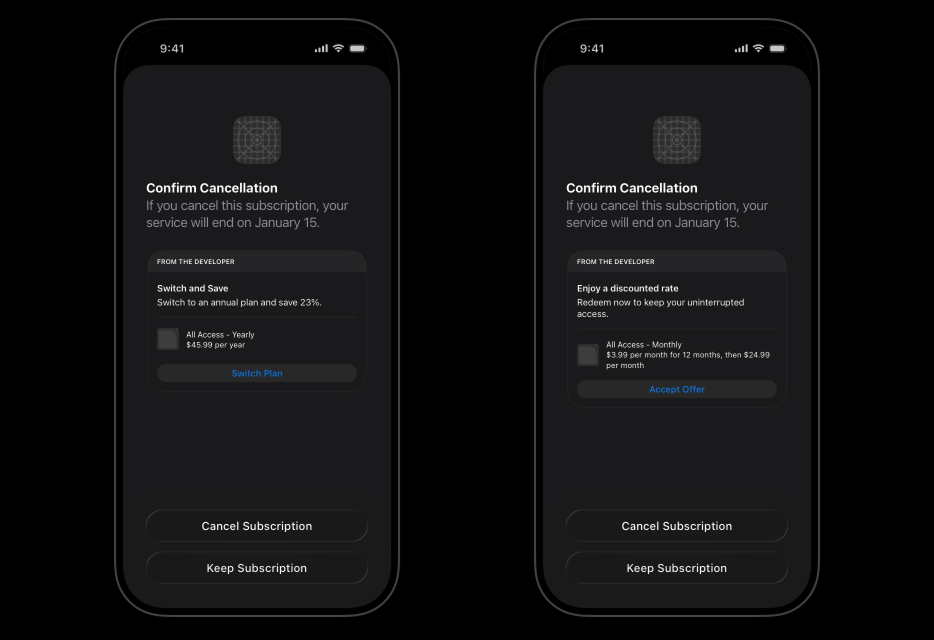
What it actually means. Until now, the only way to catch a cancellation was to intercept the user inside the app before they reached the system settings, which most users skip entirely. The system flow itself was a one-click exit. Apple is now closing that gap, which is a real win for any product running on in-app subscriptions.
“Cancel flow is the most underrated point in the funnel for native apps. On the web, a well-built cancel flow with survey screens, a personal offer, pause, and downgrade saves a double-digit percentage of cancellations — that's literally free money. In the App Store, this point of contact simply didn't exist: the user left through system settings, and the developer found out after the fact.
That's why Retention Messaging is a mandatory test for everyone. No code, configured in App Store Connect, nothing to lose. The trap is obvious too: Apple's system flow will almost certainly be tight on format — likely one message or offer, no full retention ladder, no branching by cancellation reason. The effectiveness will be orders of magnitude below a custom web flow. But the comparison shouldn't be against the web. It's against the zero that existed before.”
— David, Head of UA, Talaboos
Personalized Collections Turn Retention Into Discovery
App Store now picks apps for the user, not the other way around.
What Apple said. Personalized Collections surface dynamically on the Apps, Games, and Search tabs, based on what the user already has installed, opens, and engages with. Each recommendation comes with a short App Note explaining why it showed up. Everything runs on-device, no user data leaves the iPhone. Launched on June 8 in the US in English, with other markets and languages rolling out over time.
What it actually means. Apple has not published the signals the algorithm uses, but the consensus across ASO sources is that product retention is one of the strongest inputs. If that reading is right, retention now does double duty: a unit economics metric and a discovery metric in the same number.
"The most interesting part here is the ranking signal. If the ASO community is right and retention becomes the key factor, the organic channel finally gets earned by the product itself, not by metadata and hacks. For UA teams there's an unexpected consequence: the quality of paid traffic starts feeding the organic. Pour in cheap traffic with poor retention, and you spoil the behavioral signals and drop out of the recommendations. Incentivized traffic and misleading creatives become more expensive than they look on the media plan.
The companion-app strategy is workable. The algorithm sees what's installed on the user's device, and complementary apps become a natural recommendation candidate."
— David, Head of UA, Talaboos
"The channel is US-only, Apple doesn't disclose the metrics, and no one has measured the actual traffic volume or conversion yet. At the same time, no dedicated resource is really needed for it. What feeds into the channel — retention, activation, engagement — we already have to improve as the product baseline. 'Preparation' for the channel is free; it overlaps with normal product work."
— Vladislav, Full Stack Developer, Talaboos
Creative Assets Decouple ASO From Release Cycles
The product page got new surface area, and the release cycle around it just decoupled from the app itself.
What Apple said. Three updates land together, shipping with iOS 27 this fall:
- Creative Assets: rich images and video can now appear in the product page header and inside search results, alongside the static screenshots that have lived there for years.
- Asset Library: a single place inside App Store Connect to store and manage all visual assets, separate from the build.
- Product Page Preview: preview the live product page across iPhone, iPad, languages, and Dark Mode before publishing.
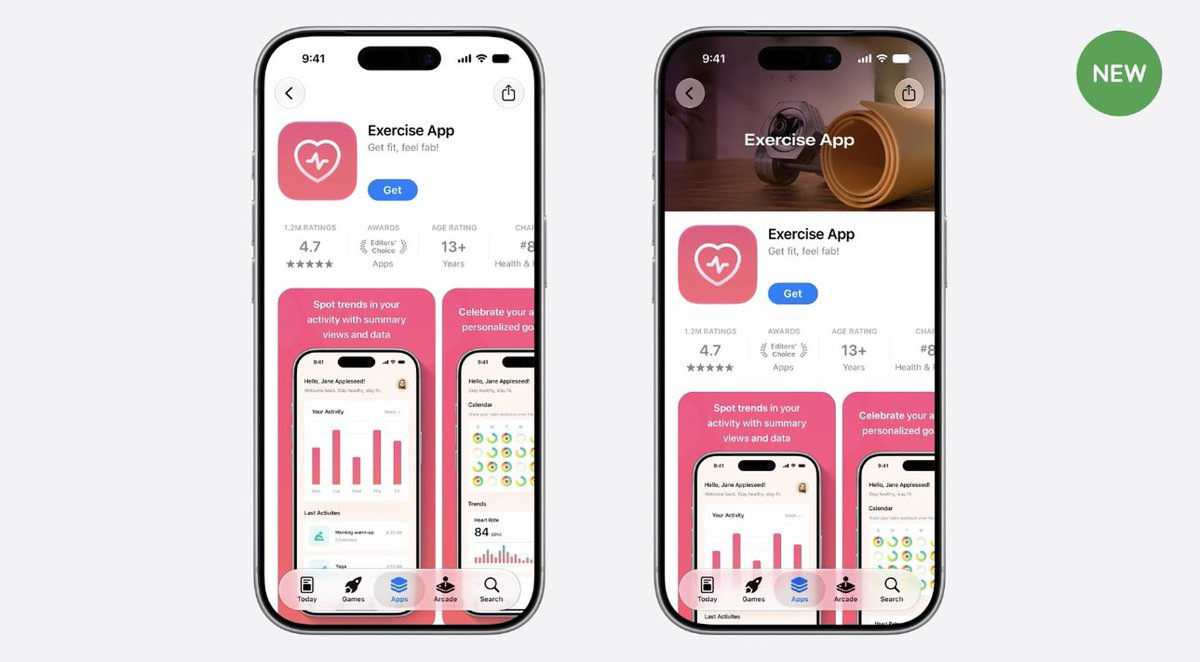
The bigger structural change: assets can now be submitted for review independently of the app binary. Updating the look of the product page no longer requires shipping a new version of the app.
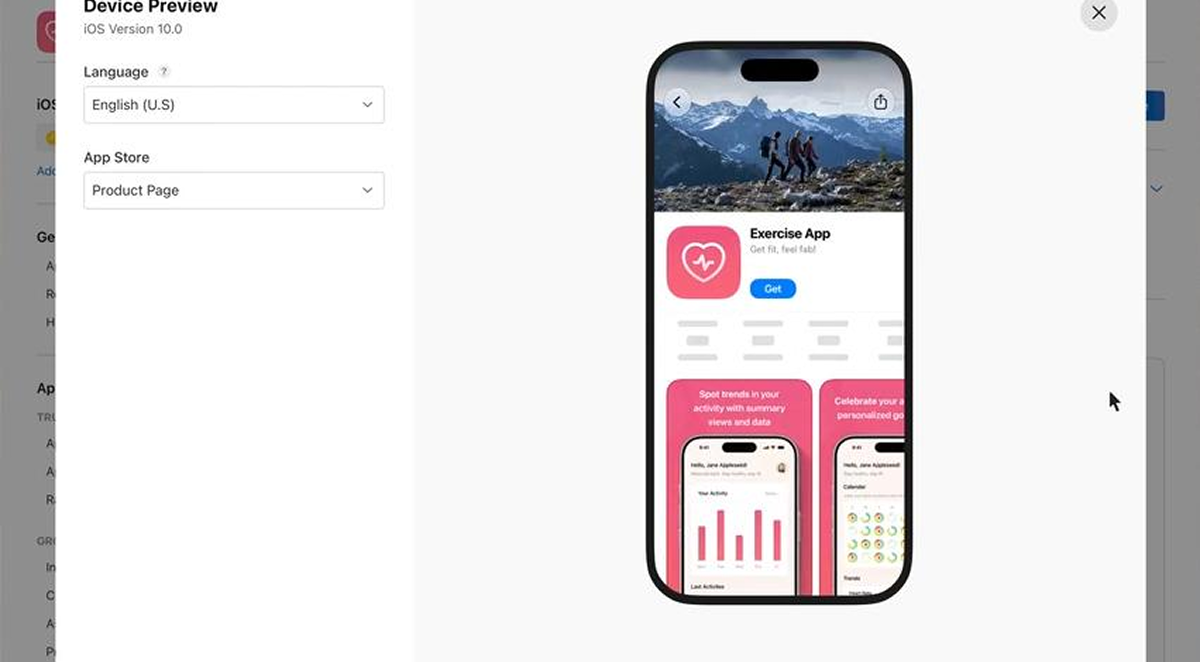
What it actually means. Decoupling visual assets from the build is the change worth tracking. The new model pulls product page work out of engineering time and into marketing time, which is where it should have been all along. Whether this turns into a meaningful conversion lever or stays a cosmetic upgrade depends on what teams do with it now that the friction is gone.
"Video and images in the header and in search results — that's the heaviest piece, and it directly affects install conversion. Separate review of assets from review of the build removes the main pain and turns the product page into a fast, independent experimentation channel, no longer tied to our deploys. A/B on creatives can now run independently of product releases. By fall, we should have a video asset ready for the header and search, build regular ASO experiments on creatives into the process now that they're decoupled from releases, and assign someone to own that cycle."
— Vladislav, Full Stack Developer, Talaboos
Foundation Models Go Free for Small Developers
Apple's biggest developer-side announcement at State of the Union, and the one where the headline and reality sit furthest apart depending on the architecture.
What Apple said. Developers enrolled in the App Store Small Business Program with under 2 million total first-time downloads get free access to Apple Foundation Models through Private Cloud Compute. AI calls that previously meant paying OpenAI, Anthropic, or Google now run on Apple's infrastructure at no cost. The same framework adds image input, server-side model support that lets developers call Claude, Gemini, and others through a single Swift API, and Dynamic Profiles for multi-agent workflows. Foundation Models framework is set to go open source in summer 2026.
What it actually means. For teams building AI natively inside iOS, this is a real win. For cross-platform stacks, the blocker is not price but platform.
"Apple is effectively subsidizing AI features for exactly the segment that previously couldn't afford LLM inference per free user: adaptive onboarding (personalizing the plan from quiz answers), generation of personalized push and notification copy, summarization of progress, a light in-app coach with a narrow scope."
— Sergey, Full Stack Developer, Talaboos
"The main blocker is the platform. Foundation Models is an on-device, Apple-only API on Swift. We run RN with a shared codebase across web, iOS, and Android. To use it, we'd write a native Swift module with an RN bridge, fork the logic into iOS / Android / web branches, and still keep our own solution for Android and web (a third-party model or API). That's an architectural tax of platform divergence for a saving that, at our scale, barely exists. It works against the main point of RN — one feature in one place.
On the horizon, something else from the same framework looks more interesting — the unified Swift API to Claude and Gemini and the open source release in summer 2026. If part of it ships separately from iOS, there's a chance to reuse without hard platform lock-in."
— Vladislav, Full Stack Developer, Talaboos
Key Takeaways
The eight announcements split into two halves. On the review side, Apple is closing the door on the lower end of the store. The 4.3 rewrite, the saturated-category rule, the social-features declaration, the Siri that only surfaces apps with real App Intents: all of this is Apple's response to the wave of vibe-coded apps and AI slop that flooded the store over the past year. ChatGPT, Claude Code, Cursor, Lovable made it trivial to ship overnight clones, and submissions jumped 84% in a single quarter. The new rules filter them out. On the monetization side, the same WWDC opened the door wider than at any point in a decade. Bundles, Suites, Group Purchases, Commitment Plan, native Retention Messaging, ASO without release cycles. For ten years Apple held all of this tight. Now it's letting go on every front at once.
The timing isn't accidental. The DMA in Europe, the DOJ antitrust case in the US, the $250M Siri marketing settlement, and the web2app funnels that quietly out-flexed the App Store for five years are all part of the context. Apple is adjusting before some of those decisions get adjusted from outside.
The catch is that the rules are still being shaped. Bundle attribution, Retention Messaging format limits, Personalized Collections signals: Apple is rolling all of this out without publishing the full mechanics. Teams that move early on any of this are going to be working with incomplete information for a while. Which, to be fair, isn't exactly new territory for anyone building subscription apps.
This is the read from inside Talaboos. Follow us on LinkedIn and X to stay in the loop — we share growth, monetization, and retention experiments from across our portfolio of apps.